 vsThe stack
Millwright vs the stack you already run
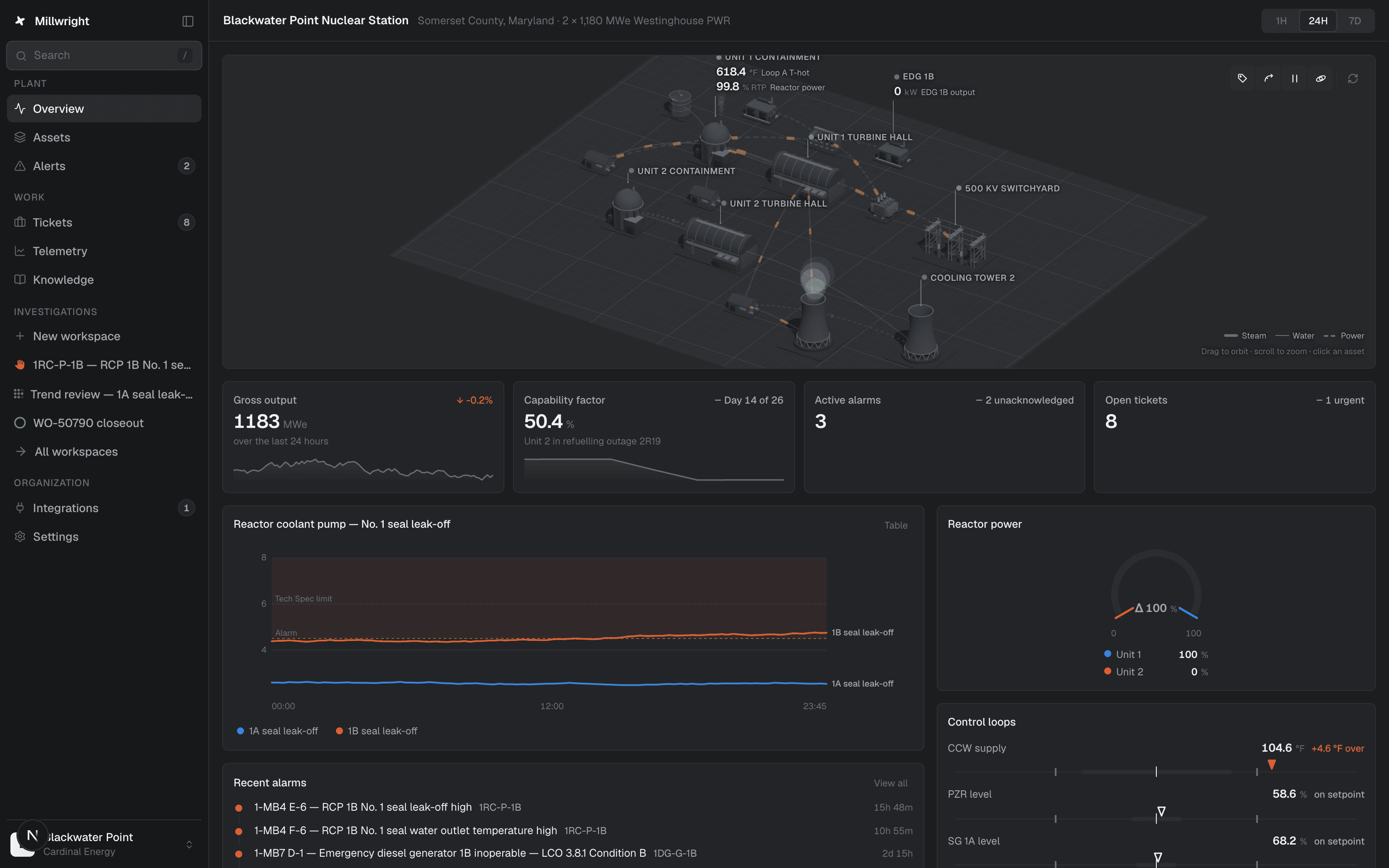
The usual alternative is not a product. It is AVEVA PI or another historian, the EAM, a procedures library in SharePoint, a board in PI Vision or Grafana, and the shift channel where someone pastes three screenshots and says what they think. Each one is load-bearing. The fault is usually in a gap between two of them, and no vendor of the five owns the gap.
- Keep The stack when
- The gaps are cheap, and the same people already hold the whole picture.
- Pick Millwright when
- The diagnosis happens in a thread full of screenshots.
 AVEVA PI
 IBM Maximo
 SharePoint
 PI Vision or Grafana
 The shift channel
Logins
- Millwright
- One workspace.
- The stack
- The historian, the CMMS, the procedures, a board, and the channel.
The trend and the ticket
- Millwright
- The same asset. The evidence stays attached.
- The stack
- A screenshot, pasted by whoever had both open.
The procedure
- Millwright
- Book, on the asset.
- The stack
- A SharePoint folder, and whichever revision search returns.
Who can see a unit
- Millwright
- Scoped to that unit, from your identity provider.
- The stack
- Whichever of the five was configured. They do not agree.
What you replace
- Millwright
- Nothing load-bearing. Read-only first. The long pole is tag review.
- The stack
- Nothing. Each system stays. So does the gap.
Alarms
- Millwright
- The ones the plant already raised. Does not write to the DCS.
- The stack
- The alarm system you have. Millwright does not ask you to change it.
The products named here are the ones a plant usually already has. Corrections.
Where the stack wins
- Each system is load-bearing, and the gaps are cheap enough to live with.
- A regulatory or contractual boundary means people cross between them by hand, on purpose.
- The crew is small enough that the same people hold the whole picture.
Where Millwright wins
- The diagnosis happens in a thread full of screenshots.
- A customer or a contractor cannot be given a login to all five.
- You want one read-only pilot, not a program to replace the stack.
How they fit together
Millwright does not replace any of the five. The first deployment is one system, read-only, measured in weeks: read access to the historian, a few afternoons of an engineer for tag review, and somewhere to run. What changes is the gap: the trend pasted into the ticket and the procedure search with three revisions. The reasoning stops leaving with the shift. Stay with the stack when the gaps are cheap or a boundary requires the systems to stay separate.
Questions
Do we have to turn off PI or Maximo?
No. Millwright connects to them and they stay the systems of record. The first step is read-only access to one system plus tag review.
We already have PI Vision and a CMMS. Isn't that this?
It is two of the five. Vision shows the trend to someone who can reach it; the CMMS holds the work for someone with that login. The procedure, the customer scope, and the reasoning tying Tuesday's trend to Tuesday's ticket are still outside both.
What does a pilot actually touch?
Read access to the historian, someone who knows the plant well enough to correct a mapping, and somewhere to run (hosted, in your account, or on the floor). No data migration, no CMMS change, nothing on the control system.



See it running on your own plant.
We are onboarding a small number of operations teams. Three questions, and we will be in touch.